Understanding Key River and Aquatic Ecosystem Terms
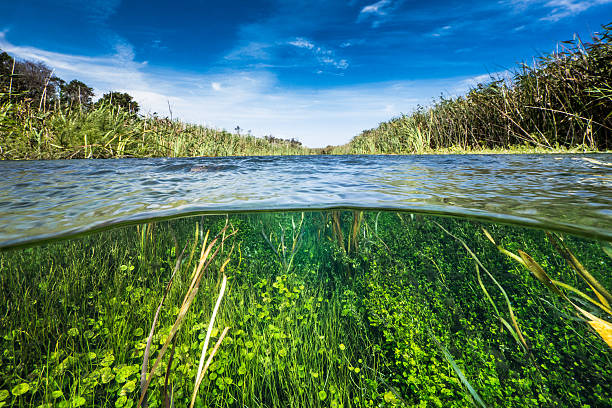
The health of our rivers and aquatic ecosystems is crucial, and a clear understanding of the associated terminology is essential for effective conservation and management. Let's delve into some important definitions.
One critical concept is an abandoned channel. This refers to a section of a stream that has become separated from the main flow, either naturally or through human intervention. These channels no longer carry surface water.
The health of an aquatic environment also hinges on abiotic factors, the non-living components of an ecosystem. These factors, which can be influenced by chemical and physical impacts, significantly affect the organisms living within the water. Conversely, abundance refers to a large quantity of individuals within a specific species, as observed during flora and fauna surveys.
Acidic conditions, indicated by a pH below 7, signal elevated levels of hydrogen ions. In contrast, an adduction zone is a vital area where water is collected. Human activities in these zones are closely regulated to prevent pollution and protect water quality. An aerobic organism or tissue requires air to survive.
When considering riverbed materials, aggregate is a general term for sand, gravel, and rocks extracted from the riverbed. In contrast, agrochemicals are chemical substances spread on the ground to improve agriculture.
Algae, a diverse group of chlorophyll-containing waterplants, are essential components of aquatic ecosystems, ranging from single-celled organisms to long-stemmed seaweeds. Their opposite, alkaline (or basic) compounds, have a pH above 7.
Alluvium, also referred to as fluvial sediments, are materials deposited by flowing water. This process can lead to the formation of alluvial plains. In addition, Amphibians form a diverse order of vertebrate animals that can live both in water and on land: eg. frogs, toads, newts, salamanders. The amplitude of flood is the difference between flow during a flood and average flow rate.
When talking about anaerobic conditions, we discuss environments lacking free oxygen. Anoxic conditions represents a more extreme absence of oxygen than anaerobic conditions. Anthropogenic modifications refer to human-made alterations of the natural environment, often seen in river systems transformed into artificial structures. An example of this are anurans or Amphibians (see definition) which do not have tails: eg. frogs, toads.
Aquaculture, the science and practice of farming aquatic organisms, plays a crucial role in food production. Aquifers are underground geologic formations, such as fractured bedrock, that hold groundwater. The Average flow refers to average annual flow (in m3/second) of a river, calculated from years of data. Lastly, artificial lake or stream is something that is man made. (Lake, stream, dam).
Understanding these basic terms will help us to protect this vital, precious resource.