Unveiling Plasmodium malariae: The "Benign" Malaria Parasite
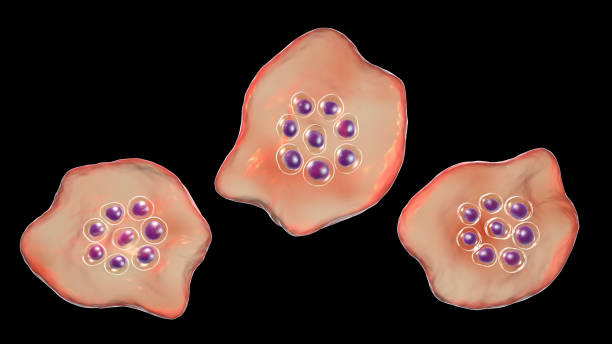
Plasmodium malariae is a parasitic protozoa and a member of the group of pathogens that causes malaria in both humans and animals. This parasite is closely related to Plasmodium falciparum and Plasmodium vivax, the more aggressive strains of malaria. While P. malariae has a global presence, it is categorized as "benign malaria" due to its lower severity when compared to infections caused by its close relatives.
P. malariae infections typically lead to fevers that recur at approximately three-day intervals, a pattern known as quartan fever. This is a longer cycle than the two-day (tertian) intervals observed in other malarial parasites. Accurate diagnosis can sometimes be challenging due to the visual similarities between P. malariae and P. knowlesi under the microscope. Accurate diagnosis often requires molecular analysis.
At the schizont stage, after schizogonic division, there are roughly 6-8 parasite cells in the erythrocyte. Microscopically, the parasitized red blood cell (erythrocyte) is never enlarged and may even appear smaller than that of normal red blood cells. The cytoplasm is not decolorized and no dots are visible on the cell surface. The food vacuole is small and the parasite is compact. Cells seldom host more than one parasite. Band forms, where the parasite forms a thick band across the width of the infected cell, are characteristic of this species. Large grains of malarial pigment are often seen in these parasites: more so than any other Plasmodium species. The merozoite count is around 8.